
 RESUME BUILDER & ATS CHECKER
A bullet point should help someone picture your contribution. “Responsible for admin tasks” names a category, but it does not explain what you handled. A stronger sentence gives the action, enough context to understand it, and a useful outcome or purpose.
You do not need a percentage in every bullet. A specific, truthful description of a process, document, customer issue, or completed project can be good evidence. The examples in this guide are fictional and show how to improve the structure of a sentence, not claims to copy into your own history.
What to take away
- Start with the contribution you personally made.
- Add the task, tool, or setting that makes the sentence specific.
- Use outcomes and numbers only when you can explain where they came from.
Sa bawat bullet, sabihin kung ano ang ginawa mo, paano mo ginawa, at ano ang naging output. Hindi kailangang may percentage o malaking numero kung wala kang record na nagpapatunay nito.
Try this with your own details
- Pick one responsibility you can explain clearly in an interview.
- Start with an action, add the task and context, then state the completed output or purpose.
- Remove vague claims and keep numbers only when you can verify them.
Use action, context, and purpose as a starting point
Try this structure: did something, using a method or tool, for a clear purpose or result. You can change the order when another version reads more naturally. The formula is a prompt to recover useful detail, not a rule that every sentence must follow.
Ask what the task involved, who used the output, and what changed after the work. If the task was routine, explain how you kept it accurate or handed it over. Routine work often matters because other people rely on it being done consistently.
Administrative work: name the process you supported
Administrative work can become invisible when all the bullets say “assisted” or “handled paperwork.” Name the schedule, record, request, or document. Explain whether you created it, checked it, maintained it, or coordinated with someone who used it.
Keep the level of responsibility accurate. Preparing an expense summary is different from approving a budget. Updating a project tracker is different from managing the whole project. A precise description lets the reader understand your contribution without an inflated title.
| Before | Clearer illustrative version |
|---|---|
| Handled schedules. | Confirmed appointment changes and updated the shared calendar before the daily team briefing. |
| Did reports. | Consolidated weekly branch submissions into a spreadsheet and flagged missing entries for supervisor review. |
| Helped with files. | Organized supplier documents by account and date, and maintained a checklist of missing records. |
Customer service: explain the response and the next step
Customer support evidence can include how you clarified an issue, checked information, explained a policy, recorded a case, or escalated a concern. Avoid claiming that you resolved every issue if some required another team’s approval.
Metrics are useful when their definition and your contribution are clear. If you mention a satisfaction score, know the period and whether it belongs to you or the whole team. If you do not have access to a reliable number, explain the service process instead.
Projects: separate your work from the team outcome
A school, volunteer, or personal project can use the same writing approach. Identify what the project was and which part you completed. Do not let “we” hide your individual contribution, and do not let “I” claim the entire group’s result.
When the outcome was a deliverable rather than a business result, say what you produced and how it was used. A tested prototype, a documented workflow, or an organized dataset is a concrete output even when there is no revenue or performance metric.
Choose accurate numbers and ordinary verbs
Use a number only when you can support it with records or a reasonable explanation. If you know a verified range, label it as a range. Avoid reverse-engineering a dramatic statistic just because resume advice says to quantify everything.
Choose verbs that fit your responsibility: prepared, checked, coordinated, reconciled, documented, tested, or explained. You do not have to use a different verb in every line. A familiar word with useful detail is better than an unusual word that exaggerates the work.
- Use present tense for ongoing responsibilities and past tense for completed work.
- Remove repeated setup such as “I was responsible for.”
- Keep one main idea in each bullet when possible.
- Check whether a confidential client or internal figure should be omitted.
Read the bullets as an interviewer would
Pick a bullet and imagine a follow-up question: how did you do that, what tool did you use, or what was your part? If you cannot answer, the sentence may need correction. Your strongest bullet is one you can discuss clearly and consistently.
Then compare the set with the vacancy. Put the most relevant contributions first, remove duplicated responsibilities, and retain enough context to understand the role. Use the space for evidence, not a longer list of synonyms for “hardworking.”
Worked resume example
Look at how the bullets describe an action, a service process, and a handover without adding invented performance figures.
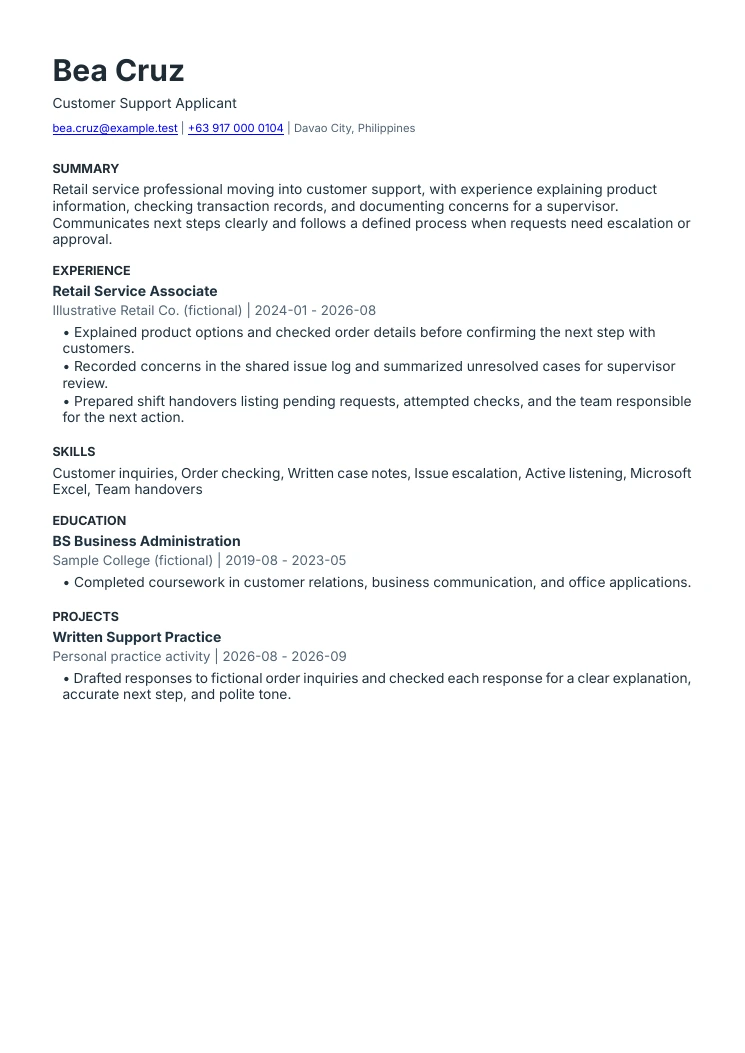
Customer service and BPO resume example
Transferable experience is explicit
The summary explains a move from retail into support. It does not present retail experience as previous contact-center employment.
Escalation is a useful contribution
Documenting an issue and handing it to the right team can show good judgment without claiming that every case was personally resolved.
No unsupported metrics are added
The sample describes the process and completed outputs. It does not invent customer satisfaction or resolution percentages.
Make your experience easier to understand.
Use the editor to revise your bullets and review each suggestion against your real work before finalizing.
Improve your resume draft Compare plans and included featuresCommon questions
What if I do not have measurable achievements?
Describe a specific contribution, the method you used, and the output or purpose. Accuracy, completed work, and a clear handover can be useful evidence without a percentage.
Can AI rewrite my bullets?
Yes, as a drafting aid. Check that the rewrite preserves your actual responsibility, tools, and outcomes. Delete any metric or claim it adds without support.
Sources & further reading
These references support specific guidance or product details. The examples and suggested workflows in this article are illustrative.
- CareerOneStop: work experience on a resume
Further reading on reviewing your responsibilities and accomplishments before writing the experience section.