
 RESUME BUILDER & ATS CHECKER
No formal employment does not mean you have no evidence to share. A school project, family business task, student organization, or volunteer activity can show how you solve problems and follow through. The key is to explain the activity honestly and make your contribution visible.
For a first job, build a resume around a realistic entry-level role. You are showing a starting point and relevant habits, rather than trying to sound like someone with years of experience. A clear example you can discuss in an interview is more useful than a senior-sounding claim.
What to take away
- Label school, personal, and volunteer experience accurately.
- Choose examples that connect to the responsibilities in the vacancy.
- Use project outputs and specific contributions as evidence.
Wala pang paid work? Puwedeng ilagay ang OJT, school projects, org activities, o volunteer work na ikaw mismo ang gumawa. Lagyan ng tamang label at ipaliwanag ang kontribusyon mo.
Try this with your own details
- Choose one real school project, internship, volunteer activity, or personal practice project.
- Write what you personally did, which tools or process you used, and what you completed.
- Keep its original label, such as School project or Registration volunteer, and connect it to your target first job.
Make an inventory before opening a template
Write down the last few activities where someone depended on you. Did you prepare a class presentation, manage an event registration sheet, help customers in a family store, or maintain a group’s social posts? Note the task, the tools, and what you completed.
Select two or three examples that connect to the role. A group research project might demonstrate checking data and organizing files. Volunteer registration might show communicating instructions and keeping records. Do not assume the connection is obvious: explain it in the bullet.
- Coursework and projects with a completed output.
- Internships or work immersion, with accurate dates and duties.
- Student leadership and volunteer responsibilities.
- Part-time, informal, or family business work, described for what it was.
- Personal practice projects that can be shown or explained.
Use your education section deliberately
List your qualification, institution, and graduation or expected graduation date. Add a relevant specialization, award, or course only when it helps the application. A long list of unrelated subjects takes space away from evidence of what you can do.
If a credential is still in progress, say so. If you attended a course but did not receive its certificate, describe your participation without claiming certification. For a regulated role, check the actual qualification requirements rather than trying to solve a missing credential through wording.
Write a project entry like a short case study
Give the project a meaningful title, identify it as a school or personal project, and state your contribution. A reader should be able to distinguish the team’s work from your own. Include a link only when you have permission and the material is appropriate to share.
Use an output you can describe accurately: a cleaned spreadsheet, a working prototype, an event plan, or a presentation. If you do not have measured results, explain the completed work and how it was used instead of inventing an improvement percentage.
Support your skills with something visible
Choose skills you can demonstrate at the level you claim. “Google Sheets: sorting, filters, and basic formulas” is more informative than “computer literate.” If you are still learning a tool, describe a practice project or training activity instead of labeling yourself an expert.
Keep the summary short. Name your course or starting point, the role you want, and a relevant strength with context. You do not need a generic objective about joining a progressive company. Give the reader useful information that the rest of the resume supports.
Make your first application easy to review
Start with a clean layout and enough space to read comfortably. One page is a useful editing target when your relevant material fits, but it is not a reason to remove essential detail or make the font tiny. Put the strongest evidence near the top.
Before sending, ask yourself whether you could explain every bullet without reading it. Remove claims you cannot support. Check that the phone number works, the email is correct, and all links open without special access. Keep a copy of the exact version you submit so you can prepare for an interview.
Worked resume example
This example uses education, volunteer registration, and a school project. Each activity retains its real type of experience.
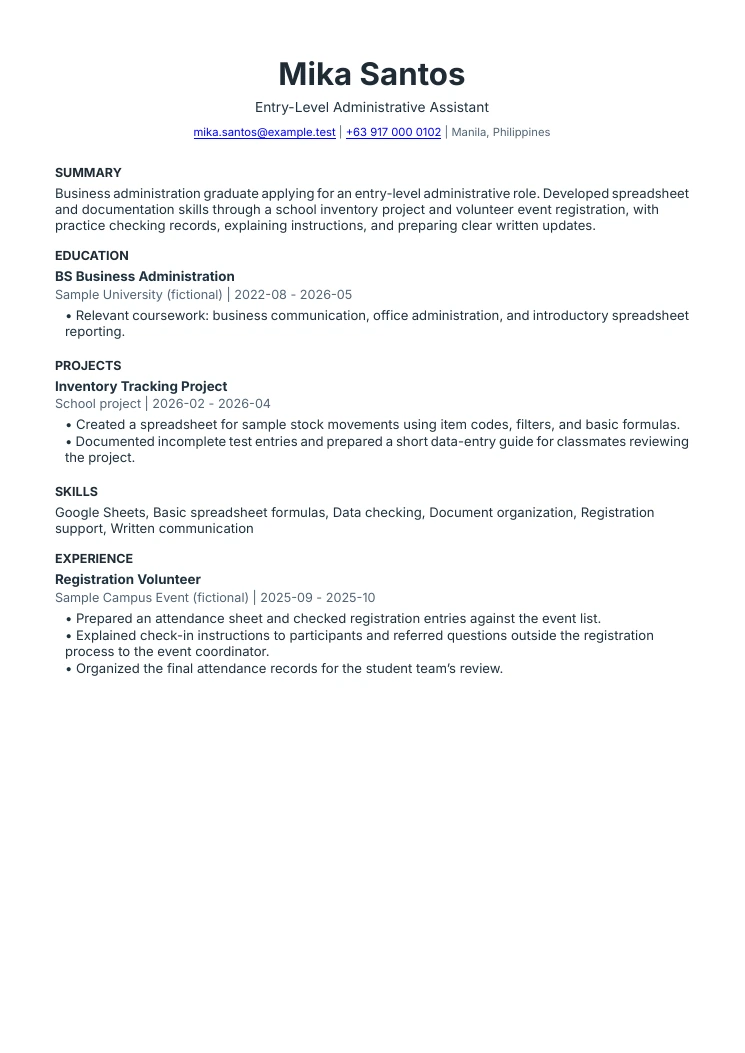
Fresh graduate resume example
Education and projects lead the story
The qualification and school project provide evidence for an entry-level role. There is no empty employment section or invented paid position.
Volunteer work keeps its real label
Registration support demonstrates organization and communication while remaining clearly identified as volunteer experience.
Skills have a visible example
Spreadsheet formulas, checking records, and preparing instructions appear in the project or volunteer responsibilities.
Start with the experience you have.
Choose a graduate-friendly layout and use the guided sections to describe projects, education, and genuine skills.
Build your first resume Compare plans and included featuresCommon questions
Should I leave the Experience section empty?
Use a more accurate heading such as Relevant Projects, Volunteer Experience, or Internship Experience when it describes your evidence. Do not add an empty section simply because a sample resume has one.
Can I include a personal practice project?
Yes. Label it as a personal project and explain what you built or practiced. Do not describe a simulated client or sample dataset as paid client work.
Sources & further reading
These references support specific guidance or product details. The examples and suggested workflows in this article are illustrative.
- CareerOneStop: sample resumes
Further reading with examples of how different backgrounds can lead to different resume structures.