
 RESUME BUILDER & ATS CHECKER
A professional summary is a short introduction to the evidence on your resume. It helps a reader understand your direction before moving into your work history. It should sound like a clear description of you, rather than a collection of attractive adjectives.
A practical starting formula is your role or background, relevant capabilities, and the context in which you used them. Two or three concise sentences are often enough. The examples below are fictional; adapt the structure using your own background instead of copying qualifications you do not have.
What to take away
- Name a relevant role or professional starting point.
- Replace broad adjectives with tools, responsibilities, and context.
- Check that the rest of your resume supports each claim.
Ikuwento muna: anong trabaho ang gusto mo, ano ang natutunan mo, at saan mo iyon nagamit? Gawing maikli at malinaw ang summary. Isama lang ang strengths na may halimbawa sa ibang bahagi ng resume.
Try this with your own details
- Note your target role, your current starting point, and two skills you have actually used.
- Write two or three sentences connecting those facts to one relevant activity.
- Check each claim against your experience, education, or projects and remove any claim you cannot support.
Build the summary after choosing your evidence
Write your experience and project sections first. Underline the details most relevant to the vacancy, then use them to draft the introduction. This keeps the summary grounded in evidence instead of forcing the rest of the document to support an exaggerated opening.
A summary does not need to include every skill or repeat your entire employment history. Pick the few details that help a reader understand why your background is relevant. Leave out a claim if it is important-sounding but too vague to explain.
Fresh graduate: connect learning to a starting role
A new graduate can introduce relevant coursework, a substantial project, or an internship. Be precise about the setting. A school project is useful evidence without being described as professional employment.
Name the role you are applying for when it helps make your direction clear. Avoid claims that suggest extensive experience if your evidence comes from student activities. You can show readiness to contribute without apologizing for being at the beginning of your career.
Virtual assistant: show the kind of support you provide
Virtual assistant roles vary considerably. A calendar-focused assistant needs a different introduction from someone handling ecommerce listings or bookkeeping support. Select responsibilities that actually appear in the vacancy and your own experience.
If you are moving from an office-based job, use that experience directly. You do not need to rewrite an old title as Virtual Assistant to explain that scheduling and email coordination are relevant to remote support.
Customer service: describe the work behind the soft skills
“Good communication” is a starting idea, not the finished sentence. Explain whether you handled in-person inquiries, email requests, phone calls, order questions, or complaint records. Add tools or processes only when you have used them.
For a first BPO application, transferable retail or volunteer experience can support the introduction. Do not imply that you have worked in a contact center if you have not. Interviewers can ask about the systems and situations you mention.
Career changer: make the connection explicit
A career change summary can connect your previous work to the target role. Identify the overlap: coordinating people, preparing reports, analyzing records, teaching a process, or supporting customers. Keep your past title and level accurate.
If you have completed relevant training, distinguish training from work experience. “Completed a personal reporting project using Excel” gives a reader a different picture from “experienced data analyst,” and the more precise statement will be easier to defend.
Run a three-question edit
Read the summary beside the vacancy. Does it identify a relevant direction? Does it contain something a reader can verify in the resume? Does it use words you would naturally say when introducing your work? If the answer is unclear, replace an adjective with a concrete detail.
AI can help shorten a sentence or suggest a clearer structure, but it can also add unsupported expertise. Compare every suggested rewrite with the original facts. Keep the version that is both specific and accurate, even if it sounds less dramatic.
- Remove unsupported years of experience, titles, and performance claims.
- Keep credentials and tool proficiency at their real level.
- Do not copy the job description into the summary.
- Read the final wording aloud before using it.
Worked resume example
Read the summary beside the experience bullets and check whether each introductory claim has supporting evidence.
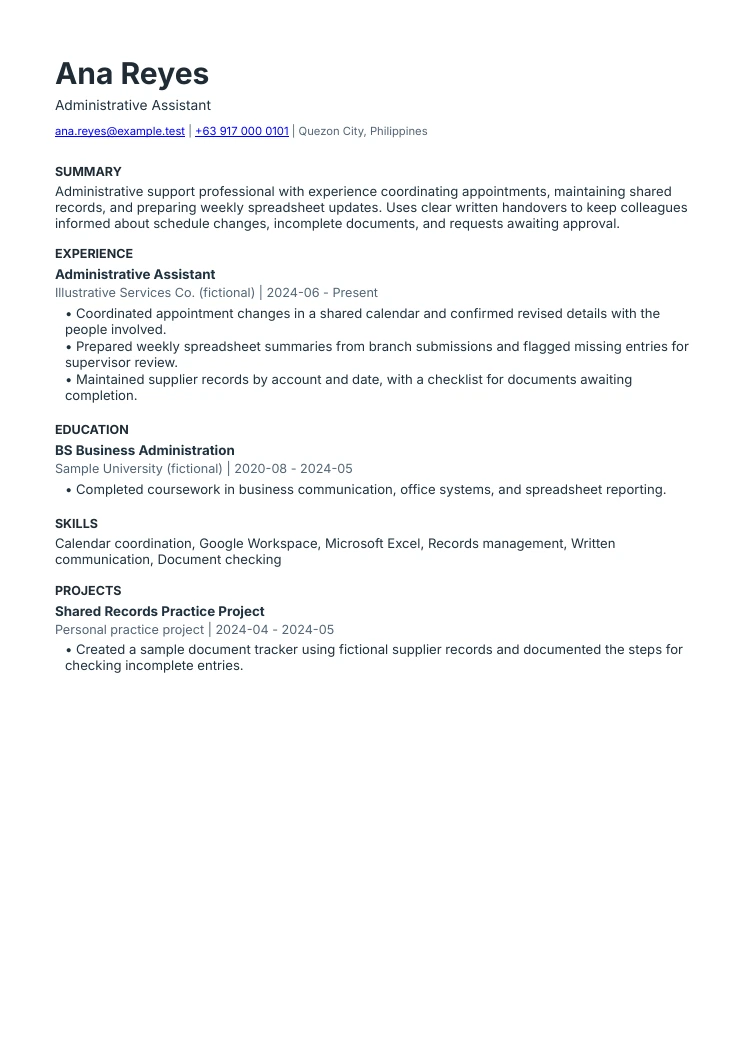
Administrative assistant resume example
The summary names actual work
Scheduling, records, and spreadsheet updates explain the type of support. The experience section provides the supporting examples.
Responsibilities have clear boundaries
Flagging an entry for supervisor review is different from approving it. This sample keeps that distinction visible.
The layout follows one reading order
Contact details, summary, experience, education, skills, and projects are text-based. The downloads are produced by the same renderer as ResumeTidy exports.
Give your introduction a clearer direction.
Draft your summary in the editor, then check that your skills and experience support it.
Open the resume builder Compare plans and included featuresCommon questions
Is a professional summary required?
No. It is useful when it gives the reader direction or explains a transition. If it adds only generic phrases, use the space for relevant experience instead.
Should I write the summary in the first person?
A resume summary can usually omit “I” and begin with the role or background. A LinkedIn About section or cover letter may use a more conversational first-person voice.
Sources & further reading
These references support specific guidance or product details. The examples and suggested workflows in this article are illustrative.
- Harvard Extension: impactful resumes and cover letters
Further reading on choosing experience and impact relevant to a particular employer.